Enterprise AI infrastructure guide
NVIDIA DGX Cloud Pricing: What Enterprise AI Teams Should Budget
NVIDIA DGX Cloud pricing is usually quote based rather than a single public GPU-hour. This guide explains what drives the quote, how to compare it with public cloud GPU rates, and which questions to answer before procurement.
Public reference rows refreshed Sep 10, 2026. They are directional benchmarks, not a DGX Cloud proposal.

Short answer: DGX Cloud pricing is a scope and capacity quote
NVIDIA DGX Cloud is an enterprise AI infrastructure service, so the price depends on the capacity reservation, region, accelerator generation, software scope, network design, storage, support, and contract term. NVIDIA's public product material does not provide one universal rate that applies to every customer. A reliable budget therefore starts with a written scope and a comparable public reference, not with an invented list price.
For an initial estimate, separate the cost of accelerator time from the cost of running a production platform. A public H100 or A100 rate can help you understand the order of magnitude of raw compute, while DGX Cloud procurement may also cover cluster orchestration, NVIDIA software, high-speed interconnects, onboarding, monitoring, and support. Those layers are the reason two quotes with the same GPU count can have very different totals.
What drives NVIDIA DGX Cloud pricing?
The word “pricing” hides several separate decisions. Ask the vendor to itemize the following lines so you can compare a DGX Cloud proposal with a public cloud VM, a specialized GPU cloud, or a purchase. If a line is bundled, request the included quantity and the overage rule.
Public GPU rates for a directional DGX Cloud comparison
These rows come from GPU Cost's tracked AWS, Azure, and Google Cloud data. They answer a narrower question than DGX Cloud pricing: “What do public GPU-backed instances cost before enterprise platform services?” Compare the same GPU generation and memory, and record the region and billing mode before drawing a conclusion.
| Provider | GPU | Instance | On-demand / GPU-hour | Spot / GPU-hour | Availability |
|---|---|---|---|---|---|
| AWS | T4G | g5g.xlarge | $0.420/hr | $0.182/hr | Check provider |
| AWS | T4 | g4dn.xlarge | $0.526/hr | $0.220/hr | Check provider |
| AWS | T4G | g5g.2xlarge | $0.556/hr | $0.249/hr | Check provider |
| AWS | T4 | g4dn.2xlarge | $0.752/hr | $0.306/hr | Check provider |
| AWS | T4G | g5g.4xlarge | $0.828/hr | $0.354/hr | Check provider |
| AWS | T4 | g4dn.12xlarge | $0.978/hr | $0.432/hr | Check provider |
| AWS | T4 | g4dn.metal | $0.978/hr | $0.440/hr | Check provider |
| AWS | A10G | g5.xlarge | $1.01/hr | $0.501/hr | Check provider |
| AWS | T4 | g4dn.4xlarge | $1.20/hr | $0.526/hr | Check provider |
| AWS | A10G | g5.2xlarge | $1.21/hr | $0.595/hr | Check provider |
| AWS | T4G | g5g.8xlarge | $1.37/hr | $0.582/hr | Check provider |
| AWS | T4G | g5g.16xlarge | $1.37/hr | $0.595/hr | Check provider |
| AWS | T4G | g5g.metal | $1.37/hr | $0.592/hr | Check provider |
| AWS | A10G | g5.12xlarge | $1.42/hr | $0.617/hr | Check provider |
| AWS | A10G | g5.4xlarge | $1.62/hr | $0.715/hr | Check provider |
| AWS | Gaudi | dl1.24xlarge | $1.64/hr | $0.638/hr | Check provider |
| AWS | L4 | g6e.xlarge | $1.86/hr | — | Check provider |
| AWS | A10G | g5.24xlarge | $2.04/hr | $0.989/hr | Check provider |
Reference refresh: Sep 10, 2026. A blank spot value means the current tracked row did not expose a spot rate.
A practical way to build a DGX Cloud budget
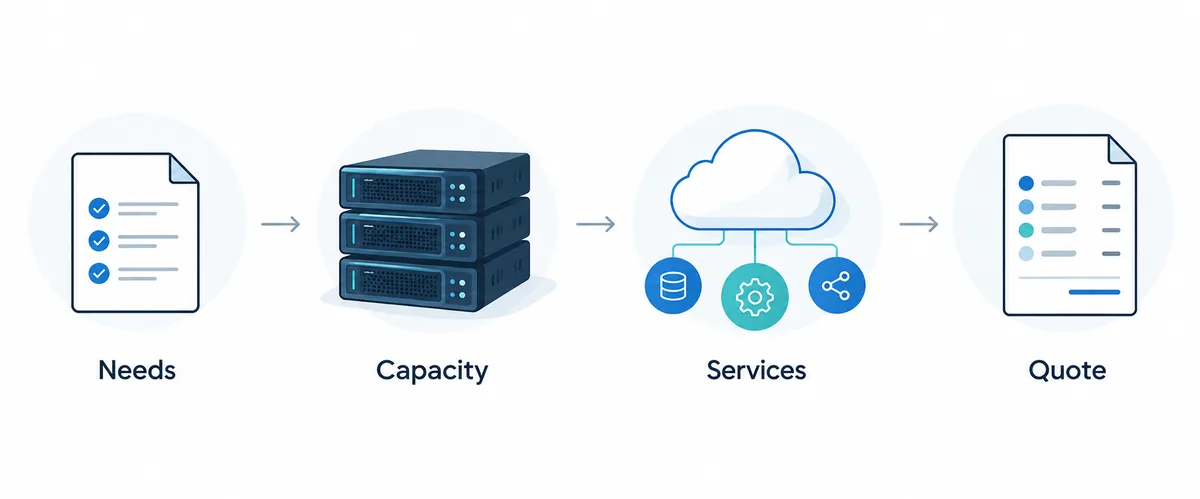
Start with the workload rather than the brand name. Write down the model size, precision, batch size, target throughput, training duration, checkpoint frequency, data location, and the number of concurrent jobs. Then ask for a quote that states the exact DGX Cloud region, GPU count, memory, interconnect, software, support tier, storage, and contract term.
Convert the proposal into one comparable unit: cost per completed training run, cost per million inference tokens, or cost per month at the measured utilization. This avoids the common mistake of comparing a fully managed reservation with a bare hourly VM. It also exposes idle capacity, queue time, preemption, data transfer, and engineering work.
Use a simple cost model
effective workload cost = capacity + storage + network + platform + support + migration + idle time
For a long training run, include checkpoint storage and recovery time. For inference, include the concurrency and latency target, warm capacity, autoscaling behavior, and the cost of keeping replicas available. For a pilot, price a short commitment and define a review point before expanding the reservation.
When DGX Cloud can make financial sense
Strong fit
- Training or inference needs predictable, contiguous NVIDIA capacity.
- The team values a supported NVIDIA software stack and faster enterprise onboarding.
- Data governance, private networking, support response, or a defined service level matters.
- Utilization is high enough to justify reserved capacity and the operating model.
Check alternatives first
- A small experiment fits on one public GPU instance or a local workstation.
- The job is bursty, checkpointed, and tolerant of marketplace interruptions.
- The proposal includes more capacity than the measured workload can keep busy.
- Your team already operates a suitable cluster and only needs incremental GPU-hours.
There is no universal winner. A managed enterprise service can be cheaper at the project level when it avoids delays, migration mistakes, or low utilization. A lower hourly marketplace price can be cheaper for a short, restart-tolerant experiment. Measure the work completed and the operational effort required.
Questions to ask before accepting a DGX Cloud quote
- Which NVIDIA GPU generation, memory size, and interconnect are included?
- Is the capacity dedicated, reserved, burstable, or shared?
- What region and data residency commitments apply?
- Are storage, egress, snapshots, and backup included or metered separately?
- Which NVIDIA software, images, orchestration, and monitoring are part of the service?
- What support response and maintenance terms are written into the agreement?
- What is the minimum term, renewal rule, and cancellation or scaling policy?
- How is idle capacity billed when a job is paused or waiting for data?
- What happens if a node or network path fails during training?
- Can the team export checkpoints and reproduce the environment elsewhere?
Ask for these answers in the same document as the price. A low number without scope is not comparable.
NVIDIA DGX Cloud pricing FAQ
How much does NVIDIA DGX Cloud cost?
NVIDIA does not publish one universal DGX Cloud hourly rate for every customer. Pricing depends on the cloud region, DGX Cloud offering, accelerator capacity, contract term, support, storage, networking, and workload requirements. Treat the official contact or quote process as the source for a real procurement number.
Is DGX Cloud priced like an AWS GPU instance?
No. An AWS GPU instance is usually a public VM SKU with a region and billing mode. DGX Cloud is an enterprise AI infrastructure service that can include reserved capacity, software, cluster networking, and support. Public GPU-hour references are useful for a directional comparison, but they are not a DGX Cloud quote.
What should a DGX Cloud budget include?
Budget for accelerator capacity, contract or reservation terms, storage, data movement, networking, managed software, support, onboarding, observability, and the engineering cost of moving data and checkpoints. Also model utilization so reserved capacity does not sit idle.
When is DGX Cloud a better fit than a GPU marketplace?
DGX Cloud is a better fit when predictable enterprise capacity, NVIDIA software integration, cluster-level performance, support, or governance matters more than the lowest possible hourly listing. A marketplace can be more economical for experiments that tolerate variable hosts and interruptions.
Can I compare DGX Cloud with H100 rental pricing?
Yes, but compare equivalent work. Record GPU generation, memory, interconnect, effective throughput, storage, data transfer, queue time, interruption risk, and support. The H100 rental calculators and cloud pricing table on GPU Cost provide public reference points without presenting them as a DGX Cloud quote.
Where can I verify NVIDIA DGX Cloud pricing?
Start with NVIDIA's official DGX Cloud page and request a current quote that states the region, capacity, software scope, contract term, and included services. Recheck the scope when a proposal changes because a capacity reservation and a public VM rate are different products.
Sources and methodology
This page uses NVIDIA's official DGX Cloud product page to confirm the service scope and quote-oriented procurement path. Public comparison rows are loaded from GPU Cost's D1 pricing records. For exact commercial terms, verify the current AWS on-demand pricing and the vendor proposal for the region and capacity you will actually use.
No numeric DGX Cloud list price is asserted here because a universal public rate was not available in the checked official material. That limitation is part of the answer: request an itemized quote and compare completed work, not an unsupported headline number.