GPU comparison guide
H100 vs H200: Specs, Price and Best AI Workloads
H200 is the memory-first upgrade: 141GB HBM3e and higher bandwidth make it easier to serve larger models, longer contexts, and bigger batches. H100 remains the value baseline when an 80GB workload already fits and the H200 rental premium does not reduce total job cost.
Pricing data refreshed Sep 10, 2026.
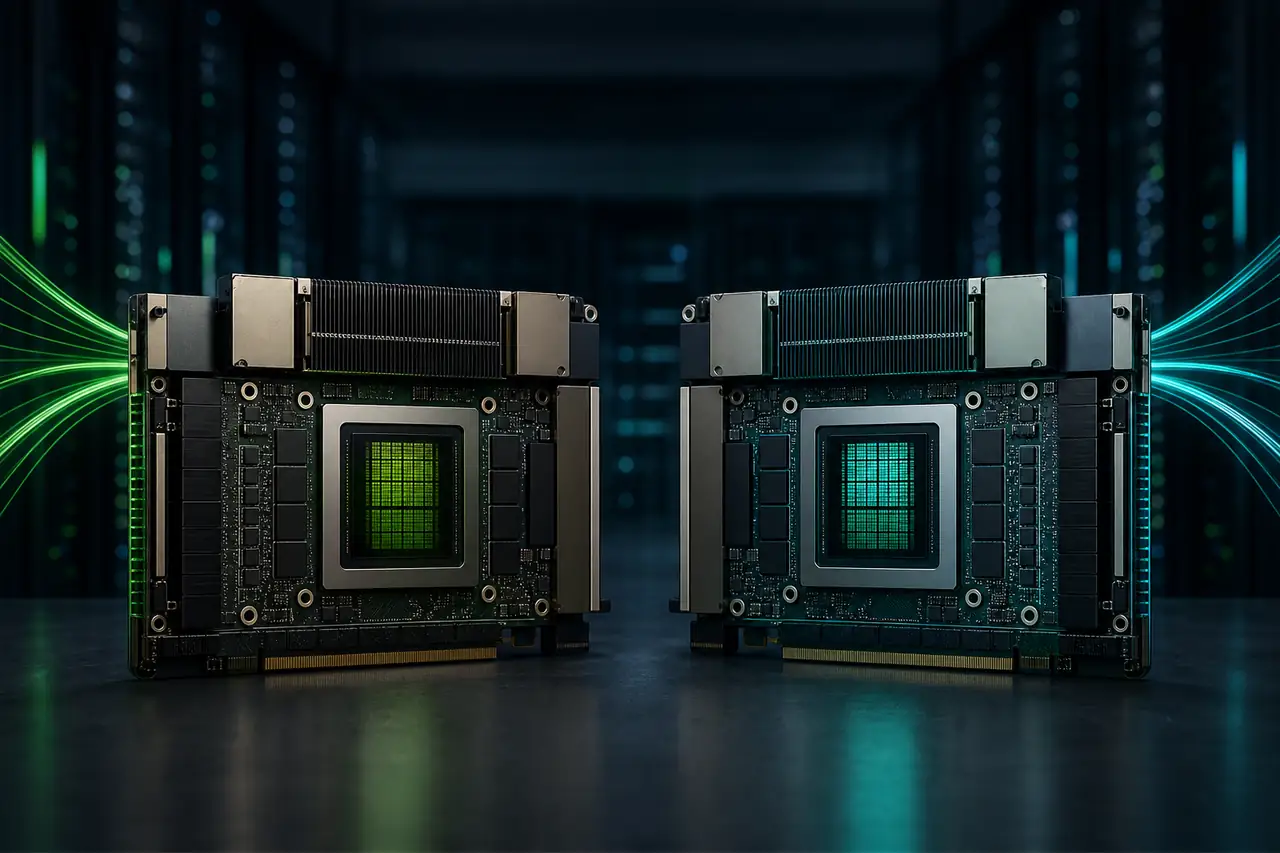
Quick verdict: choose H200 for memory, H100 for value
Choose H200 when 80GB is the bottleneck, when a larger KV cache improves concurrency, or when avoiding tensor parallelism saves enough engineering and communication overhead. Choose H100 when the model and batch fit in memory, the software stack is already tuned, and a lower hourly rate beats the H200 speed or capacity advantage.
H100 vs H200 specifications
Both accelerators use NVIDIA Hopper architecture. H200 is not a completely different compute generation; its practical advantage is the larger, faster memory subsystem. Exact PCIe, SXM, and NVL configurations can differ.
| Decision factor | H100 | H200 | Why it matters |
|---|---|---|---|
| Architecture | Hopper | Hopper | Software compatibility is similar; the biggest purchase decision is memory capacity, bandwidth, configuration, and price. |
| GPU memory | 80GB HBM3 | 141GB HBM3e | H200 holds larger models, longer contexts, larger batches, or more KV cache on one GPU. |
| Memory bandwidth | 3,350 GB/s | 4,800 GB/s | Higher bandwidth helps memory-bound inference and training stages feed the compute units more quickly. |
| Power envelope | 700W class | 700W class | Cloud bills normally hide facility power, but owned clusters must budget rack density, cooling, and power delivery. |
| Lowest tracked rental | $1.47/GPU-hour | $2.30/GPU-hour | The cheaper hourly GPU is not always the cheaper completed job; benchmark wall-clock runtime and GPU count. |
When H200 memory changes the architecture
Moving from 80GB to 141GB is valuable only when it changes how the workload runs. A larger model may fit on one H200 instead of being split across two H100s. A serving endpoint may keep a larger KV cache, increase batch size, or support longer contexts without moving data between GPUs.
That can reduce tensor-parallel communication, simplify deployment, and free CPU and network resources. The benefit is smaller when the model already fits comfortably in H100 memory or the application is compute-bound rather than memory-bound.
- Strong H200 fit: very large LLM inference, long context, retrieval-heavy prompts, large KV caches, memory-bound scientific workloads.
- Strong H100 fit: models below the memory ceiling, standard fine-tuning, mature production stacks, jobs where hourly price dominates.
- Benchmark required: distributed training, mixed precision, custom kernels, or workloads with uncertain communication overhead.
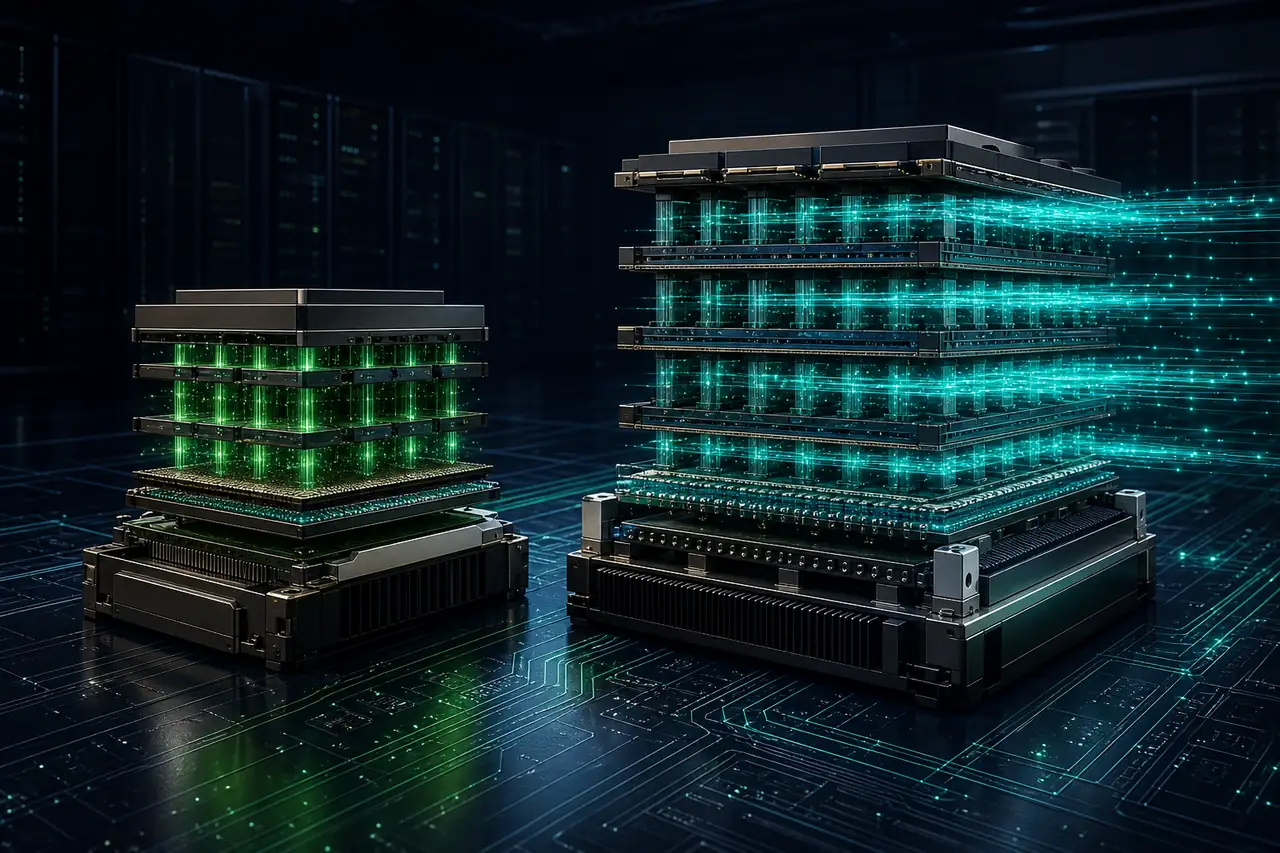

Best GPU by workload
| Workload | Default | Decision logic |
|---|---|---|
| LLM pretraining | Benchmark both | H200 helps when memory or communication limits scale; H100 may remain cheaper if compute utilization and cluster supply are stronger. |
| Large-model inference | H200 | More memory supports larger weights, longer contexts, bigger KV caches, and fewer shards. |
| LoRA or QLoRA fine-tuning | H100 first | If the adapted model fits in 80GB, H100 commonly offers the better budget starting point. |
| High-concurrency serving | H200 | Extra memory can increase batch size and cached tokens, but validate latency and tokens per dollar. |
| Embeddings and smaller inference | H100 or cheaper GPU | Neither premium GPU may be cost-efficient when L4, L40S, or A100 satisfies latency and memory needs. |
| Owned datacenter deployment | TCO model | Include server, networking, cooling, power, support, depreciation, and utilization—not the accelerator alone. |
H100 vs H200 price and break-even
Start with current provider rates, then replace headline speed claims with a short benchmark of your container, model, sequence length, batch size, precision, and serving framework.
Measure throughput, latency, memory use, failures, and wall-clock time before reserving capacity.
Add storage, egress, idle time, platform fees, support, and reservation commitments.
H200 lowers compute cost only when saved GPU-hours or reduced GPU count exceed its price premium.
Model the full schedule with the H100 rental cost calculator and H200 rental cost calculator. Review current offers on cloud GPU pricing and compare detailed hardware pages for H100 and H200 NVL.
Four-step H100 vs H200 decision
Measure peak memory
Include weights, optimizer state, activations, temporary buffers, KV cache, and framework overhead.
Test one real workload
Use the same model, precision, context, batch, container, and service-level target on both GPUs.
Calculate total job cost
Multiply rate by GPU count and runtime, then include idle capacity, storage, egress, and failed runs.
Check capacity risk
Confirm region, cluster size, interconnect, reservation terms, availability, and provider support.
Migration and capacity checks before switching
A move from H100 to H200 should be operationally simpler than a full architecture change, but it still deserves a controlled rollout. Confirm the provider exposes the same CUDA, driver, container, storage, networking, and orchestration assumptions used by the current deployment. Re-run memory profiling because a larger GPU can encourage bigger batches or contexts that change latency and queue behavior.
For inference, compare p50 and p99 latency, tokens per second, time to first token, maximum stable concurrency, and cost per million tokens. For training, compare step time, checkpoint duration, effective throughput after data loading, multi-GPU communication, and recovery from interruptions. A faster benchmark that violates the required quality, latency, or reliability target is not a valid saving.
Capacity also matters. A provider may list an attractive single-GPU H200 price while lacking the contiguous eight-GPU nodes, region, network fabric, reservation term, or support level required by production. Keep H100 as the fallback when its supply and tested operating profile reduce deployment risk.
Official specification sources
GPU Cost pricing is dynamic. Specification context is checked against NVIDIA's official product pages; cloud providers may expose different form factors, power limits, networking, and regional availability.
H100 vs H200 FAQ
Is H200 better than H100?
H200 is better when its extra memory and bandwidth remove a bottleneck. H100 can be the better value when an 80GB workload already fits and measured performance does not offset the H200 rental premium.
Does H200 have more memory than H100?
Yes. H200 commonly provides 141GB HBM3e, compared with 80GB HBM3 on common H100 configurations. Verify the exact cloud instance because form factors and configurations vary.
Is H200 faster for LLM inference?
It can be, especially for memory-bound serving, larger batches, long contexts, and large KV caches. The improvement depends on model architecture, precision, framework, and latency target.
Should I upgrade an H100 deployment to H200?
Upgrade only after a representative benchmark shows that extra memory, fewer shards, higher throughput, or simpler operations justify migration and rental cost.
Which is cheaper to rent?
H100 is often cheaper per GPU-hour, while H200 can be cheaper per completed job when it reduces runtime or GPU count enough. Use live provider rows and your own benchmark.