GPU comparison guide
H100 vs A100: Which NVIDIA GPU Should You Rent or Buy?
H100 is the faster, newer choice for transformer training, FP8 workloads, and high-throughput inference. A100 remains the value pick when your model fits, your stack is already tuned, or hourly price matters more than absolute speed.
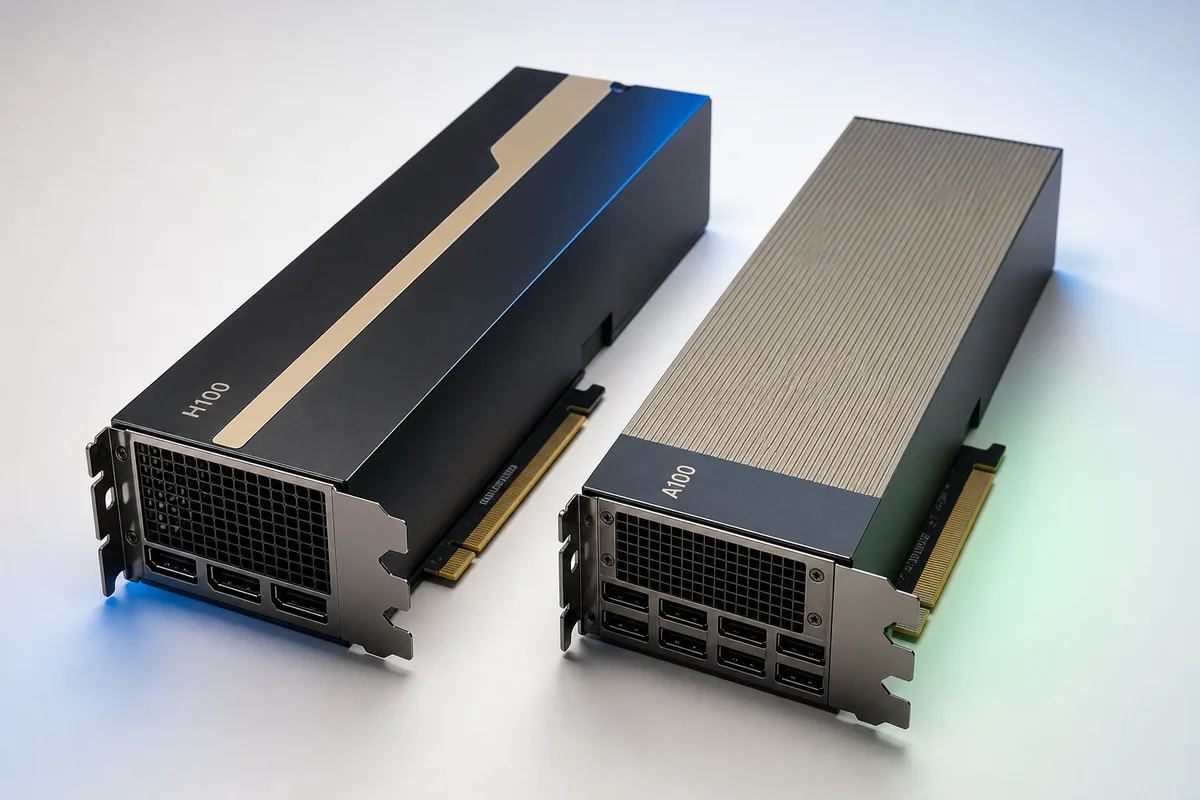
Pricing snapshot refreshed Sep 10, 2026.
Quick verdict: H100 for speed, A100 for value
Choose H100 if you are training or serving modern transformer models where FP8, higher memory bandwidth, NVLink cluster scaling, or faster time-to-result changes the project economics. Choose A100 if you need dependable 40GB or 80GB GPU memory at a lower hourly rate, especially for fine-tuning, batch inference, notebooks, Stable Diffusion pipelines, and workloads already validated on Ampere.
If 80GB is the limiting factor rather than compute generation, compare the H100 vs H200 memory and rental-cost tradeoff.
H100 vs A100 specifications that affect cost
Specs are not the whole decision, but they explain why H100 usually earns its premium on newer AI workloads. Use this table with the live rental rows below instead of comparing list prices alone.
| Decision factor | H100 | A100 | What it means |
|---|---|---|---|
| Architecture | Hopper | Ampere | Hopper adds transformer-focused acceleration and FP8 support; Ampere remains widely supported and predictable. |
| GPU memory | 94GB HBM3 | 80GB HBM2e | Both can handle large single-GPU models, but H100 moves data faster and is better for high-throughput batches. |
| Memory bandwidth | 3900 GB/s | 2039 GB/s | Bandwidth matters for training, long-context inference, and workloads that keep the GPU waiting on memory. |
| Tensor performance | 1979 TFLOPS class | 312 TFLOPS class | H100 can finish supported tensor workloads much faster, but only if software uses the newer precision modes effectively. |
| Lowest tracked cloud rate | $2.27/GPU-hour | $1.30/GPU-hour | Compare total job cost, not hourly rate alone: a faster H100 can still be cheaper if it cuts runtime enough. |
Best GPU by workload
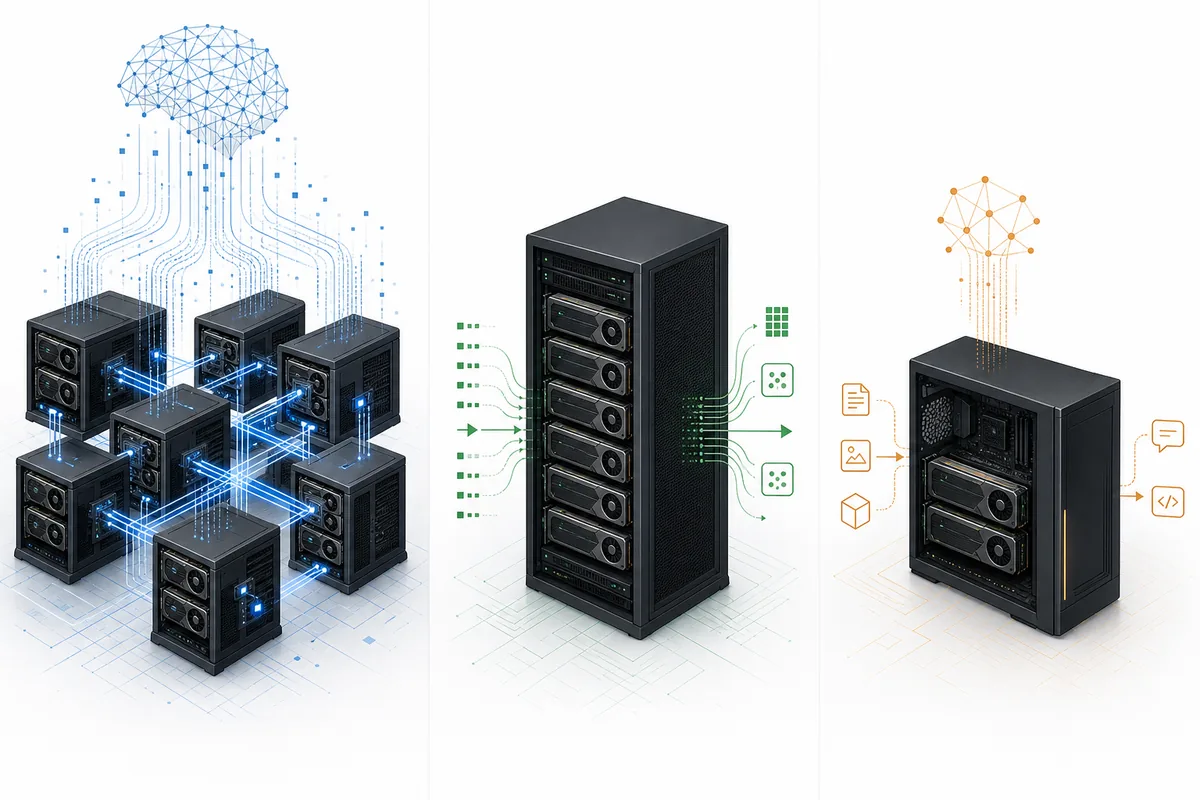
The practical H100 vs A100 decision starts with workload fit. If the job is memory-bound, precision-sensitive, or multi-GPU, H100 can justify its price. If the job is stable, smaller, or interactive, A100 often leaves more budget for experiments.
| Workload | Default pick | Why |
|---|---|---|
| LLM pretraining or large-scale training | H100 | FP8 support, higher bandwidth, and cluster interconnects usually matter more than the hourly premium. |
| QLoRA or LoRA fine-tuning under 80GB | A100 first | A100 40GB or 80GB often delivers enough memory at a lower rate; upgrade only when runtime blocks iteration. |
| Production LLM inference | Depends | H100 wins for high tokens/second and large batches; A100 can win for steady smaller models and mature serving stacks. |
| Stable Diffusion, image generation, notebooks | A100 | These workloads rarely need Hopper-specific acceleration and are often price-sensitive. |
| HPC or FP64-heavy jobs | Benchmark both | H100 has much stronger headline compute, but real speedups depend on kernels, precision, and power limits. |
| Legacy CUDA production stack | A100 | A100 has broad availability and fewer migration surprises when the software was built around Ampere. |
Rental cost: compare job cost, not just hourly price
A100 usually has the lower hourly rate. H100 wins financially only when the speedup is large enough to offset the premium or when a faster result has business value. For each provider quote, calculate both the hourly bill and the expected wall-clock runtime.
Good for benchmarking your actual container before committing to a longer reservation.
Useful for always-on inference, internal platforms, and long-running notebooks.
If H100 costs twice as much, it needs roughly a 2x runtime reduction before it lowers pure compute cost.
For a precise estimate, run both the H100 rental calculator and the A100 rental calculator with your GPU count, utilization, storage, egress, support, and failed-run overhead.
Live pricing snapshot
These rows use the current GPU Cost database where provider pricing is available. Treat them as a shortlist, then verify region, availability, storage, networking, and reservation terms on the provider page before purchasing.
H100 NVL
- Lowest tracked rental
- $2.27/hr
- Market hardware price
- $35.0k
- Tracked providers
- 2
A100 SXM
- Lowest tracked rental
- $1.30/hr
- Market hardware price
- $12.0k
- Tracked providers
- 8
A practical decision framework
Start with model memory
If the model, optimizer state, KV cache, or batch size does not fit, the cheaper GPU is not actually cheaper. Confirm VRAM first.
Benchmark one real job
Run your own container for a small training or inference batch. Record wall-clock time, GPU utilization, memory pressure, and failure rate.
Price the complete environment
Include storage, bandwidth, idle notebooks, reserved minimums, support, image build time, and spot interruption recovery.
Choose for the next bottleneck
Buy or reserve H100 only if compute is the bottleneck. If data loading, engineering time, or model quality is the bottleneck, A100 can be enough.
Sources and verification notes
GPU Cost combines provider pricing rows with official NVIDIA specification references. Specs vary by SXM, PCIe, NVL, and cloud instance configuration, so use provider instance pages for final procurement decisions.
H100 vs A100 FAQ
Is H100 better than A100?
Yes for most new transformer training, FP8-capable inference, and large multi-GPU clusters. Not always for cost: if the workload fits A100 and does not use Hopper-specific acceleration, A100 can produce a lower total bill.
Is A100 still worth renting in 2026?
Yes. A100 remains useful for fine-tuning, 40GB or 80GB memory jobs, notebooks, Stable Diffusion, batch inference, and teams with mature Ampere-validated software stacks.
When does H100 become cheaper than A100?
H100 becomes cheaper when its runtime reduction is larger than its hourly price premium. If H100 costs twice as much per hour, it needs to finish in less than half the time to win on compute cost alone.
Should I buy H100 or A100 hardware?
Rent first unless you have predictable utilization, datacenter capacity, support, and a clear depreciation plan. Buying makes more sense for steady high utilization; renting is safer for experiments and short projects.
Which GPU is better for LLM inference?
H100 is usually better for high-throughput inference and larger batches. A100 can still be better for smaller models, lower traffic, and deployments where the lower hourly rate matters more than peak tokens per second.